
The Law of Work
  • Home
  • About
  • Professor David Doorey
  • In the Media
  • Books
  • Guest Contributors
  • Useful Links
    • Archive
  • Home
  • About
  • Professor David Doorey
  • In the Media
  • Books
  • Guest Contributors
  • Useful Links
    • Archive
The Law of Work
Collective BargainingFreedom of AssociationUnions and Collective Bargaining

Models of Broader-Based Collective Bargaining: A Roadmap Forward

by David Doorey January 16, 2026
written by David Doorey January 16, 2026

By David Doorey, York University

It is no secret that the model of collective bargaining we have used in Canada since the 1940s is no longer fit for purpose in the 21st century.  The so-called “Wagner model” still works well enough in those workplaces for which it was designed, mainly large workplaces with dozens or hundreds of employees who work relatively predictable shifts. However, even in those workplaces, the model struggles to embed collective bargaining when employers absolutely refuse to tolerate it. Just look at the labour battles being waged at the Walmarts and Amazons of the world, American employers who take anti-unionism to a religious fervour.

For most private sector employees, the odds of ever having working conditions set through collective bargaining rather than employer fiat are extremely small. Private sector union density today sits around 15 percent of the Canadian workforce, which is lower than it was before “modern” collective bargaining legislation was first introduced in the 1940s.
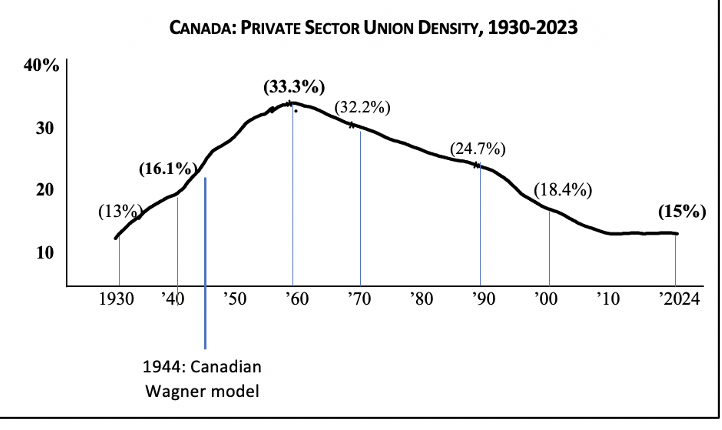
In labour law reform discussions, the idea of “broader-based” collective bargaining models is often floated as possible solution to the shortcomings of the Wagner model, which favours workplace level bargaining.  In fact, almost every labour law reform commission report issued since the 1990s has recommended that the government strike a committee to study the possibility of broader-based bargaining models for Canada.  Incredibly, no government has ever taken this step.  It is time.

In this Working Paper, I summarize the model I have proposed for years as a means for thinking about 21st century labour law reform.  That model is presented as “nabla” with the long-standing “Wagner model” in the middle. I’m largely uninterested in the many well-known reforms to the Wagner model that have been floated, and often enacted and then repealed, for 40 odd years.  None of those reforms will alter the overall downward trend in private sector collective bargaining in Canada.
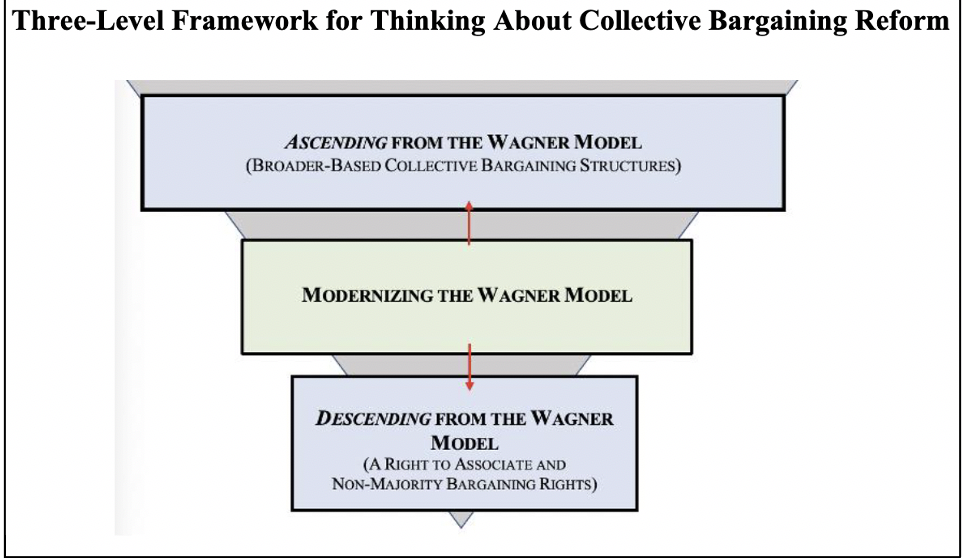
The real meat worth more discussion lies in what I call strategies of “descension” and “ascension” from the Wagner model’s focus on workplace level bargaining.   Descension strategies focus on legal rights of the individual worker and other forms of collective action that do not depend upon majority trade unionism.  Ascension strategies focus on moving upwards from the workplace level bargaining that dominates the Wagner model, towards broader based collective bargaining.  This Working Paper focused on the latter strategies and describes the many models of broader-based bargaining that have been proposed for Canada (and mostly not adopted) and that have been proposed (and sometimes adopted) in other countries, including New Zealand, Australia, the USA, and the UK.  I conclude by revisiting the many recommendations for Canadian governments to strike expert committees to study broader-based bargaining.

DISCUSSION PAPER THE ‘ASCENSION’ STRATEGY FOR CANADIAN LABOUR LAW REFORM: OPTIONS FOR BROADER BASED COLLECTIVE BARGAINING

DAVID J. DOOREY


0 comment
1
FacebookTwitterLinkedinEmail
David Doorey

Professor Doorey is a Full Professor of Work Law and Labour Relations at York University. He is Academic Director of Osgoode Hall Law School’s executive LLM Program in Labour and Employment Law and a Senior Research Associate at Harvard Law School’s Labor and Worklife Program. Professor Doorey is a graduate of Osgoode Hall Law School (LL.B., Ph.D), London School of Economics (LLM Labour Law), and the University of Toronto (B.A., M.I.R.).

previous post
Doorey: My Submission to Senate Committee Studying the Use of Section 107 of Canada Labour Code to End Strikes
next post
My Upcoming Talk at Queens Law School on Government Intervention in Strikes

You may also like

Did the Laurentian President Violate the Labour Relations...

January 30, 2026

My Upcoming Talk at Queens Law School on...

January 30, 2026

Doorey: My Submission to Senate Committee Studying the...

December 16, 2025

The Unionization of the New Toronto Tempo Players:...

October 30, 2025

What Does Quebec’s Bill 89 Mean For the...

September 4, 2025

So Long Section 107 of the Canada Labour...

August 26, 2025

How Three Simple Labor Laws Helped Unions Organize...

August 7, 2025

What If UBER is a Federal Undertaking?

July 4, 2025

DHL Requests Permission to Violate Labour Laws

June 19, 2025

Ontario’s Controversial Bill 5 and Labour Rights: A...

June 6, 2025


Follow Us On Social Media

Substack
Bluesky

BlueSky Latest Posts

No posts available.

Categories

  • Alberta
  • Artificial Intelligence
  • Australia
  • British Columbia
  • Charter of Rights and Freedoms
  • Childcare
  • Class Action
  • Climate and Just Transition
  • Collective Bargaining
  • Common Law of Employment
  • Comparative Work Law
  • competition law
  • construction
  • Constructive Dismissal
  • COVID-19
  • Diversity
  • Employee Classification
  • Employment Insurance
  • Employment Regulation
  • Europe
  • Financial Industry
  • Fissured Work
  • Freedom of Association
  • frustration of contract
  • Gender
  • Gig Work
  • Health and Safety
  • Health Care
  • Human Rights
  • Immigration
  • Interest Arbitration
  • International Law
  • Labour Arbitration
  • Labour Economics
  • Law of Work Archive
  • Legal Profession
  • Manitoba
  • Migrant Workers
  • Minimum Wage
  • New Zealand
  • Newfoundland
  • Nova Scotia
  • OLRB
  • Ontario
  • Pension Bankruptcy
  • Privacy
  • Public Sector
  • Quebec
  • Real Life Pleadings
  • Saskatchewan
  • Scholarship
  • Sports Labour
  • Strikes and Lockouts
  • Student Post
  • Supreme Court of Canada
  • Tax Law
  • technology
  • Transnational Law
  • Uncategorized
  • Unions and Collective Bargaining
  • United States
  • Videos
  • Women and Work
  • Wrongful Dismissal
  • Home
  • About
  • Guest Contributors
Menu
  • Home
  • About
  • Guest Contributors
  • Legal Scholarship
  • Useful Links
  • Archive
Menu
  • Legal Scholarship
  • Useful Links
  • Archive

2020. Canadian Law of Work Forum. All Rights Reserved.