
By David Doorey, Professor of Law, York University
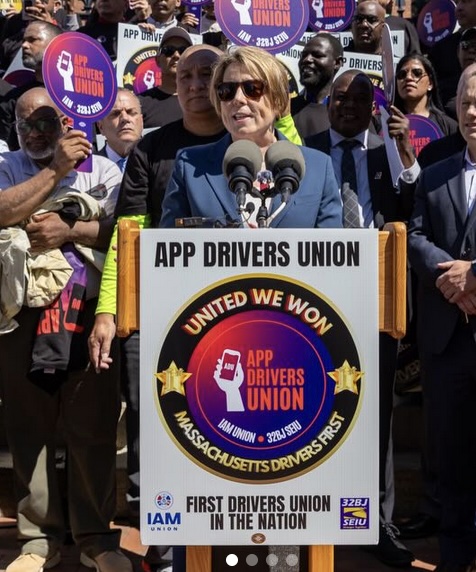
This week, the Massachusetts Department of Labor Relations certified—get this—a union to represent a bargaining unit compromised of some 70,000 platform-based drivers in the state! Here is an excellent summary from David Madland of the Centre for American Progress, who suggests that this is the largest bargaining unit to be certified in the U.S. since 1941.
What is this all about? Well, the App Drivers Union (ADU) was certified as the exclusive bargaining agent for all App-based drivers pursuant to a state law that created a model of sectoral collective bargaining for this industry. The model is fascinating. Moreover, it could work, with some tweaks, in Canada.
I have talked about sectoral bargaining several times before and I have on several occasions analyzed how various models would work in Canada. So, in that spirit, here is my quick and dirty explanation of the Massachusetts industry level bargaining model and my analysis of how that model would fit into the Canadian labour relations system.
(See some of my earlier posts on this subject here)
How New Zealand’s New Sectoral Collective Bargaining Model Would Work in Canada
* Narrator’s Voice: The New Zealand law was repealed.
The Model of Sectoral Collective Bargaining Everyone is Whispering About
Explaining how the “Baigent-Ready” model proposed for BC many years ago would work.
Models of Broader-Based Collective Bargaining: A Roadmap Forward?
The Parties to the Sectoral Model
Firstly, the law defines the three principal parties to the model. The companies are known as Transportation Network Companies (TNC) and they include all platform-based service companies in Massachusetts that use drivers (excepting companies that don’t really provide services to individuals). The unions are known as Transportation Network Driver Organizations (TND Orgs).
The drivers are known as Transportation Network Drivers (TND). There is math involved in determining who qualifies as TND. It is not every driver. Basically, the law requires that the drivers have some longevity to qualify. It does this by calculating a “median number of rides” across all drivers of all TNCs over a 6-month period. Any driver who has completed more rides than the median over the relevant 6-month period is a TND. The Mass. Employment relations board (Board) does this math and the TNCs are required to submit driver information quarterly once the Board asks to enable the calculations.
Canadian Notes: There’s nothing stopping a Canadian labour law from enacting a similar formula for rides within a province (or city/municipality, if the law was more constrained).
Unfair Labour Practices and Rights of TNDs
Sections 3 and 4 of the legislation reproduces most of the unfair labour practice provisions we are used to seeing in the American NLRA and in Canadian labour relations legislation. So, TNDs have a right to associate and form and join TND Orgs without interference, threats, or punishment at the hands of TNCs. It is illegal, for example, for a TNC to de-activate a driver as punishment for supporting collective bargaining or engaging in protected concerted activity.
Section 4 requires the parties to bargain in good faith once a TNC Org is certified or voluntarily recognized. A lockout, which means de-activation from the App, is not permitted “except for good cause” unrelated to the exercise of rights under the legislation. Presumably this means that drivers can be suspended for misbehaviour or violating rules that are not related to associational activity. This is true of any employee under labour relations legislation in Canada and the USA. There is a law prohibiting TNCs from “spying” on drivers who are exercising associational activities.
The law imposes a typical duty of fair representation on certified TND Orgs, which is potentially a huge challenge for the union just certified given that there are 70,000 drivers, huge turnover, and at any time probably hundreds are not even aware that there is a union. But the challenge of servicing a 70,000 person bargaining unit is a discussion for another day.
These ULP laws are enforced by complaints filed at the Board, and the Board can hold hearings and issue decisions, similar to how Canadian labour boards enforce ULP complaints.
Canadian Notes: Again, there is nothing particularly unusual in these ULP provisions. Canadian labour boards have decades of experience dealing with laws like these and, in fact, the standard ULP provisions already apply to Uber, Lyft, etc by virtue of the fact that drivers for these companies are “dependent contractors” under Canadian labour law and covered collective bargaining laws. See Foodora decision and note that Uber expressly agreed that its drivers in Victoria BC are “dependent contractors” and therefore covered by the BC Labour Relations Code. Those Uber drivers are now subject to a collective agreement bargained by UFCW.
Maybe there’s an argument for creating a new labour tribunal charged with enforcing the sectoral bargaining system if for no other reason than our existing labour boards are extremely overburdened with everything else. But there is no argument about whether unfair labour practice provisions like those in the Mass. Law could be implemented and applied to platform-based drivers.
How a TND Organization (Union) Obtains Bargaining Rights
Here’s where things get interesting.
The first thing to note is the law specifies that the bargaining unit is all TNDs in Massachusetts. This is industry level bargaining. Then the law explains how a TND Org gets certified. The first step is for the TND Org. to collect evidence of TND support, just like Canadian laws require. This evidence can be in the form of a standard union membership card (paper or digital) or a petition. In practice, it looks like union collected evidence of support by including a digital union membership card directly on the home page of its website (scroll down to the “Sign the Card” header.)
The TND Org. can begin the process by submitting evidence on behalf of at least 5% of TNDs. This is a very low threshold, but all this does is formally begin the organizing process. If the Board confirms there’s 5% support, then it notifies the TNCs and orders them to send a message out to all drivers that the union has commenced an organizing campaign under the law. The TNCs must also then provide the names and full contact information for all “active TNDs” to facilitate communication between the TND Org and the drivers.
Canadian note: Canadian labour laws do not generally require employers to provide unions with contact information to facilitate communication (unlike US and UK law, for example). This has long been an issue of debate in labour law circles, since if the whole point of a model requiring unions to obtain majority employee support is to encourage employees to make informed choices, why shouldn’t the law actually encourage informed choices by making it possible for unions to communicate with workers? I wrote about that issue way back in 2010 in this article on Union Access to Workers. Ontario passed a law in 2017 that entitled unions to employee contact information once the union collected at least 20% support in a proposed bargaining unit (see Sch. C, s. 6.1(6)), but the Doug Ford Conservatives repealed the law. But there is no reason at all why a Canadian law could not require platform-companies to provide contact for drivers to a union that is actively organizing drivers.
Armed now with the contract information of the drivers, the TND Org can launch its full scale campaign by emailing drivers, organizing live and online meetings, developing websites, et cetera. The Org then has two choices that roughly parallel how Canadian labour law works:
- Ask for a certification vote based on the 5% support. This would presumably be a big gamble since the union would have little idea what level of support it has and the TNCs would no doubt campaign against the union as employers typically do.
- Gather at least 25% support of TNDs and apply for certification based on what is essentially a card-check model. If the Board confirms 25% or more, it will certify the TND Org. as the exclusive bargaining agent for all TNDs in Mass.
There are other rules about what happens if two or more TND Orgs apply at once or if there is evidence that at least 25% do NOT want the Org to represent them. Essentially, in these cases, the Board is to conduct a ballot that includes the choice of any union with at least 25% or a NO option, and there is provision for a run-off ballot. But let’s not worry about that any more here.
Canadian note: Canadian labour legislation permits a certification vote if a union applies with something less than 50% support but more than 35-45% (depending on the jurisdiction) support. And some jurisdictions allow for certification based on union membership evidence alone (card-check) based on levels of support ranging from 50% plus 1 to 55% in BC and 60% in New Brunswick. So, the percentage of support is much lower under the Mass law. BUT keep in mind the scale we are talking about. For a bargaining unit of 70,000 workers, the union needed to get support of at least 17,500 drivers to reach the 25% threshold. That would probably amount to largest organizing success in Canada, at least going back decades (if not all time). Also, remember that all the certification does is get the union a license to bargain a collective agreement. As we will see, that agreement still needs to be accepted by a majority of TNDs or the union can be decertified. So, arguments that the model is somehow “undemocratic” do not hold water.
How Does Collective Bargaining Work?
Now that the TND Org is certified in Mass., collective bargaining will begin. All TNCs are notified of the certification and all of them are bound by the duty to bargain in good faith. The law indicates that the TNCs can elect to form an industry association to represent them in bargaining. However, if no industry association is created, then there are rules for ratifying a collective agreement:
The CBA must be agreed to by at least 2 industry member TNCs AND member TNCs representing at least 80% of market share of that industry in MASS, with votes determined in proportion to number of rides completed by TNDs contracting directly with the TNC in the 2 calendar quarters preceding the recognition of the Org. (Section 6).
That’s a little complicated, but the Board is keeping track of all the statistics based on information that is required to be submitted by TNCs on a regular basis. That’s the “joy” of dealing with this companies that basically gather stats on everything.
On the driver side, the law essentially creates a voting constituency for the purposes of ratification votes. That constituency includes any TND who has “completed at least 100 trips in the previous quarter”. Those drivers vote on any proposed agreement. If they vote No, then bargaining must resume.
If they vote “YES”, the proposed settlement still needs to be signed off by the Mass. Secretary of Labor, who can also reject the agreement as being contrary to the goals and policies of the state in addressing working conditions in the platform work industry. The Secretary of Labor can also modify the terms of the agreement mid-term if “market conditions” change.
Canadian note: This model is a variation on standard collective agreement ratification rules we have in Canada. We have a long history of requiring employees to vote in favour of a proposed settlement, failing which the duty to bargain resumes. There’s a variation in terms of which employees get to vote that accounts for the transient nature of the workforce. Workers need to demonstrate a basic commitment to the industry in the form of a minimum number of “rides”, but the model is basically just a ratification model we are used to. The fact that the ultimate decision is up to the Secretary of Labor is a twist on the model that ensures a level of public policy oversight over the bargaining results.
Note that in a talk I did on the future of labour law in Canada (the Sefton-Williams Lecture) a few year back, I proposed that governments assign actors in an industry (including the platform work industry) to propose or bargain a sectoral model or agreement that would then be signed off by the government and become law, or parts of it would be approved by the Minister of Labour and other parts rejected or reformed. I called this approach “regulated self-regulation”. This is essentially what is happening in Mass.
What if a Collective Bargaining Impasse is Reached?
The Mass. law declares that a bargaining “impasse” may be reached if the parties fail to reach an agreement by the end of 180 days since the Org. was deemed the exclusive bargaining agent. At that point, either party can request government assistance. First, the government can appoint a mediator who has 30 days to help the parties reach a deal (like our conciliators). If the mediator can’t help the parties reach a deal, either party can request the appointment of an arbitrator. There are rules about how an arbitrator is selected if the parties can’t agree.
Note though that before an arbitrator is appointed, a vote is taken of the voting constituency mentioned above (TNDs with at least 100 rides), who are given two options: (1) refer to binding arbitration or (2) decertify the TND Org. This model roughly parallels the laws in Canada that permit workers to apply to decertify the union in certain defined time periods after an agreement is failed to be reached, accept the Mass law imposes a vote. An interesting variation.
If the TNDs vote to decertify, the game is over. If they vote for arbitration, then a final binding arbitration process kicks in that requires the arbitrator to “make a just and reasonable determination of the matters in dispute.” Imagine a big-Whig arbitrator like Bill Kaplan parachuting in to arbitrate the dispute.
The law includes factors to be considered that are not unlike what we are used to seeing in Canadian laws imposing binding interest arbitration (ability to pay, impact on services) and some we aren’t used to seeing, including a requirement to consider “cost of living” and the need for wages that are sufficient enough that TNDs “do not need to rely upon public benefits”.
The arbitrator’s decision (plus any items previously agreed by the parties) become the proposed collective agreement that is sent to the ratification process described above and then eventually to the Secretary of Labor for sign-off.
Canadian Lens: The details of this scheme are novel, but the overall sentiment of the laws is familiar. The model essentially parallels the Canadian system of conciliation and then binding arbitration if no deal is reached, which is common in a lot of Canadian sectors. The Mass law does not talk about strikes, but the “right to engage in concerted activities” includes a right to strike in the USA, and that law is in the Mass law. I guess that means that TNDs could strike, although I’m not 100% sure about that. In practice though, since the law gives either party the right to binding arbitration, strikes seem unlikely. A Canadian law could include a right to strike/lockout, but it could also adopt a similar model to the Mass law and impose binding arbitration. Binding arbitration could be challenged as a Charter violation, but I wonder if a union in Canada would not actually prefer binding arbitration in an industry-wide platform bargaining unit. Coordinating a strike would be daunting task in an industry where new workers can join the platform at any time and workers are scattered across a huge geographic area (especially if there no anti-scab legislation in place).
The mandatory vote to decide on arbitration or decertification is unusual in design, but not really spirit. Whenever bargaining breaks down, unions are vulnerable to a decertification drive. The Mass law puts the matter to a direct vote, presumably because it would be impossible for drivers to organize a standard petition for decertification since the drivers don’t know each other and have limited means to communicate.
Concluding Thoughts on a Canadian Equivalent to the Massachusetts model
The key takeaway from this summary of the Massachusetts sectoral bargaining model in the platform driver industry is that there is absolutely nothing stopping a Canadian government from adopting a similar model, except political will and imagination. The contours of the model are set out in the Mass law.
Much of the model already aligns with the basic infrastructure of our labour laws. The major differences involve (1) formulas for determining who qualifies as an driver under the model for the purposes of tabulating percentages in the certification, collective agreement ratification, and decertification processes; (2) formulas for managing the employer’s ratification process when the companies elect not to be represented by an industry association; (3) the introduction of a vote to decide if workers want binding arbitration or decertification; and (4) the requirement for the Secretary of Labor to sign-off on the proposed deal and the power of the Secretary to amend the deal. There is nothing in Canadian law that would prevent these changes to be implement into a Canadian sectoral bargaining model.
My own preliminary thought is that there is a lot good in this model. I think Canadian governments should seriously consider a model like this, not only for the platform-driver industry, but for other low-wage, precarious industries where traditional Wagner-style collective bargaining has never, and will never take hold.
Thoughts?
DD