

By David Doorey, York University
The Sudbury Star recently published an op-ed by the President and Vice Chancellor of Laurentian University. A poll appears at the end of the article that I assume was added by the newspaper, although there was some confusion initially about whether the poll was part of the op-ed itself and included by the President. That would have been an idiotic move, since nothing good could come from a poll like this for the employer.
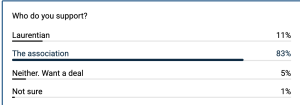
The poll asks readers who they support in the ongoing labour dispute that has seen the professors on strike since January 19. It asks simply, Who do you support? Four options are provided: (1) Laurentian; (2) The association; (3) Neither, Want a Deal; and (4) Not sure. The poll was posted yesterday (Jan 29) and as of the moment I am writing this, the results are 83% in favour of the profs/association and only 11% in favour of the employer. Take from that what you want.
I’m more interested in the substance of the op-ed. Let’s play a little game I sometimes play on this blog when I ask whether public comments during collective bargaining violate labour laws. The question for today is:
Did the President violate the Labour Relations Act in her comments in the article?
For labour law students out there, let’s think this through.
Let’s start with the law. The Ontario Labour Relations Act (Section 70) permits employers to present their views about unions, collective bargaining, and work stoppages, provided in expressing those views the employer does not “use coercion, intimidation, threats, promises, or undue influence.” An employer that is in bargaining also cannot by-pass the union and bargain directly with the employees, but again, it can put out statements explaining its opinion on how the bargaining is going, provided it does not say things about the union and bargaining that are untrue and that it does not make offers to the employees that it has not already offered to the union in negotiations.
With this in mind, we can safely say that an employer cannot come into bargaining and say “unless you agree to our final offer, we will be left with no choice but to fire half the employees”. Nor can it tell employees that they will lose their jobs if they insist on supporting the union. That would be a threat, coercion, and intimidation. These are easy cases.
But most employers, at least those who have any knowledge of labour law or who have received legal advice, do not so blatantly break the law. Sometimes the threat of job security is more subtle.
I worked on a case way back in the late 1990s when I was working in the legal department of the United Steelworkers called United Steelworkers of America v Wal-Mart Canada, Inc. In that case, the OLRB ruled that WalMart violated Section 70 by subtly threatening the job security of the workers in the days preceding a certification vote. There was no overt threat by Walmart that it would close the store if the workers or fire any employees if they voted to unionize. But the OLRB found that two incidents in particular planted the seed in the minds of employees that a YES vote for the union could threaten their employment.
Firstly, Walmart permitted one of the employees who was against unionization to make a speech at the workplace in which she intimated that Walmart would “not put up with” a union. The managers there did not refute the claim and ended the meeting before anyone could challenge the employee’s claim.
Secondly, Walmart distributed a Q&A document and the first question was “Is it true” that Walmart will close the store if the workers unionize? Walmart’s cute answer was “It would be inappropriate for your Company to comment on what it will or will not do if the store is unionized.” The second question asked if it was true that it would be illegal for Walmart to close the store if workers unionized, to which Walmart responded: “This statement is not factually correct”.
What’s important for our purposes is the approach that the OLRB took in the Walmart decision in deciding that these two events amounted to unlawful intimidation, threats, and coercion. It is not necessary for an employer to come right out and make an explicit threat. Rather, the test, as applied in the Walmart decision, is essentially “What would a reasonable or average employee in the circumstances think upon hearing or reading the comments?” Would a reasonable or average employee believe, as a result of the comments, that there is a possible link between supporting the union and their job security. If the answer is that the average employee would believe that continuing to support the union could imperil their job, then the comments are probably illegal.
Now, with that legal background, take a look at the Laurentian President’s comments in the Sudbury Star. I recommend you go read the entire article. I’ve pulled out the parts that I think are most pertinent to our analysis. In particular, I have underlined some key parts:
I have been deeply affected by the stories I have heard about what it was like to be part of [the restructuring process at Laurentian]. Students didn’t know if their programs would continue and whether they would be able to complete their studies. Faculty and staff feared for their jobs, and many, sadly, were let go…
The university is doing everything it can to bring an end to the strike. It cannot afford what the Laurentian University Faculty Association has asked for at the bargaining table, which far exceeds our financial means….
Having emerged from the turbulent period of financial insolvency, we have a responsibility to work within the established parameters and to make decisions that will support the university’s long-term viability. To do otherwise would be to repeat the mistakes of the past.
What do you think?
Could you make an argument that these passages together tell a story that goes like this: The university has already fired professors in the recent past because of financial difficulties. The Association is asking in negotiations for stuff that the university cannot afford. If the Association continues to insist on these bargaining positions, it will threaten the “viability” of the university and this would lead to a repeat of the past, which as noted, included terminations of professors.
From that story, could the OLRB find that a “reasonable Laurentian professor” reading the comments would conclude that there is a real chance that unless the Association accepts what the University is offering or significantly reduces what it is asking for, that I may lose my job?
If so, do you think that means that the President’s comments in the paper amount to an unfair labour practice, a violation of Section 70 of the Labour Relations Act? Why or why not? What would the President/University argue in its defence? [I haven’t talked about Section 17 in this post, the duty to bargain in good faith, but that section could also be engaged if the OLRB believed that the comments in the paper were threatening].
If a breach of the OLRA did occur, what remedy do you think the OLRB would order? The Walmart case involved a union organizing campaign that was undermined by the company’s unlawful threats and the remedy was certification of the union. In this case, the comments are made in the context of collective bargaining and a strike. What can a labour board do in terms of remedy when an employer makes unlawful comments related to the bargaining?
An interesting story for discussion in Labour Law class!
/DD