
The Law of Work
  • Home
  • About
  • Professor David Doorey
  • In the Media
  • Books
  • Guest Contributors
  • Useful Links
    • Archive
  • Home
  • About
  • Professor David Doorey
  • In the Media
  • Books
  • Guest Contributors
  • Useful Links
    • Archive
The Law of Work
Charter of Rights and FreedomsCollective BargainingFreedom of AssociationStrikes and LockoutsUnions and Collective Bargaining

My “Beginner’s Guide” to Collective Bargaining History

by David Doorey September 9, 2026
written by David Doorey September 9, 2026

Year’s ago I wrote a “beginner’s guide” to the Charter of Rights and Freedoms and Work Law because I taught that topic and there was no good reading on the subject matter written for people without a background in the area. And the law and legal history is complicated!  So a “beginner’s guide” attempts to explain complex subject matter to readers coming into the area cold, without any previous knowledge of the subject matter.

[This has reminded me that I need to update the Charter paper, since Section 2(d) litigation is constant and the court’s reasoning … er …. is fluid.]

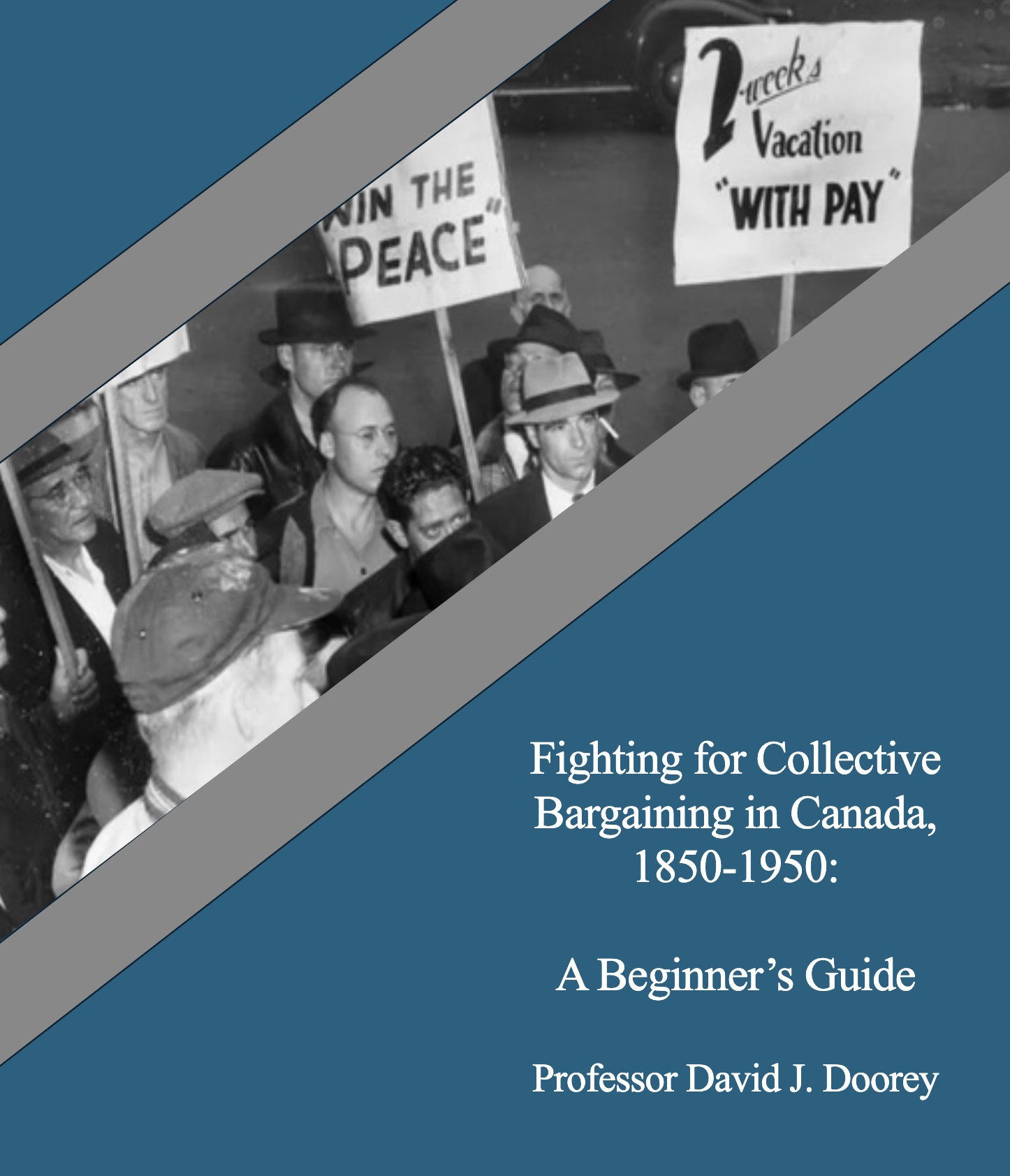
Now, in honour of Labour Day, I have posted a new “beginner’s guide”.  This one traces a century of efforts by Canadian workers to do something quite straightforward: join with their coworkers to bargain working conditions as a group rather than as individuals. The paper (or maybe we can call it a mini-ebook) covers the period running roughly 1850 to 1950.  I stop in 1950 because I’m most interested in the story about how we ended up with the collective bargaining model that we still use today in most industries, known as the Canadian “Wagner model”.

You can download the paper here:

“Fighting for Collective Bargaining in Canada, 1850 – 1950: A Beginner’s Guide”

A key lesson, well known to labour history folks, is that this model was introduced primarily to control and restrict strikes in large industrial workplaces during World War II.  The model struck a compromise: the state would require employers to bargain with unions that can prove majority employee support, but in exchange workers and unions could no longer strike to win recognition or during a collective agreement. All strikes were illegal except those involving employees represented by a majority trade union that has satisfied a series of legal prerequisites during a period when there is no collective agreement in force.

Thus, the model created one of the narrowest rights to strike in the Western world. Still, the model was eventually adopted across Canada and it did quite well at creating access to collective bargaining in those industries for which it was designed: large industrial workplaces with hundreds or thousands of employees reporting to workplace at relatively predictable times. It also eventually worked well in large public sector workplaces.

However, the Canadian Wagner model was never designed to facilitate collective bargaining in smaller workplaces, the service sector with contingent and sporadic work forces and working hours, or in multi-layered business structures like franchises, modern-day “platform” work, or in large organizations that operate through many small outlets (think bank branches, retail stores).  Our governments were not thinking about collective bargaining in those sorts of workplaces in the 1940s. It is hardly surprising that a model designed to control strikes in huge industrial workplaces is ill-suited to facilitate access to collective bargaining for the millions of Canadian workers who do not work in large industrial workplaces or the public sector.

Having an understanding of how and why Canada adopted the collective bargaining model we have used for some 80 years helps us understand both why the model may be ill-suited to Canada’s 21st century workplaces.  It also provides hints as to what circumstances might be needed to bring about the next major collective bargaining revolution.


0 comment
0
FacebookTwitterLinkedinEmail
David Doorey

Professor Doorey is a Full Professor of Work Law and Labour Relations at York University. He is Academic Director of Osgoode Hall Law School’s executive LLM Program in Labour and Employment Law and a Senior Research Associate at Harvard Law School’s Labor and Worklife Program. Professor Doorey is a graduate of Osgoode Hall Law School (LL.B., Ph.D), London School of Economics (LLM Labour Law), and the University of Toronto (B.A., M.I.R.).

previous post
Does Canadian Labour Law Protect Concerted Activities by Employees?

You may also like

Does Canadian Labour Law Protect Concerted Activities by...

August 18, 2026

The Odyssey: Amazon’s Desperate Fight to Avoid a...

August 14, 2026

Here’s What’s In the First UBER Collective Agreement...

May 28, 2026

Could the Massachusetts Sectoral Bargaining Model for Platform...

May 27, 2026

ICJ: ILO Convention 87 Protects a Right to...

May 21, 2026

Backgrounder for Canadians on the Big International Court...

May 20, 2026

What Is a Lockout of Non-Union Workers?

May 12, 2026

Did the Laurentian President Violate the Labour Relations...

January 30, 2026

My Upcoming Talk at Queens Law School on...

January 30, 2026

Models of Broader-Based Collective Bargaining: A Roadmap Forward

January 16, 2026


Follow Us On Social Media

Substack
Bluesky

BlueSky Latest Posts

No posts available.

Categories

  • Alberta
  • Artificial Intelligence
  • Australia
  • British Columbia
  • Charter of Rights and Freedoms
  • Childcare
  • Class Action
  • Climate and Just Transition
  • Collective Bargaining
  • Common Law of Employment
  • Comparative Work Law
  • competition law
  • construction
  • Constructive Dismissal
  • COVID-19
  • Diversity
  • Employee Classification
  • Employment Insurance
  • Employment Regulation
  • Europe
  • Financial Industry
  • Fissured Work
  • Freedom of Association
  • frustration of contract
  • Gender
  • Gig Work
  • Health and Safety
  • Health Care
  • Human Rights
  • Immigration
  • Interest Arbitration
  • International Law
  • Labour Arbitration
  • Labour Economics
  • Law of Work Archive
  • Legal Profession
  • Manitoba
  • Migrant Workers
  • Minimum Wage
  • New Zealand
  • Newfoundland
  • Nova Scotia
  • OLRB
  • Ontario
  • Pension Bankruptcy
  • Privacy
  • Public Sector
  • Quebec
  • Real Life Pleadings
  • Saskatchewan
  • Scholarship
  • Sports Labour
  • Strikes and Lockouts
  • Student Post
  • Supreme Court of Canada
  • Tax Law
  • technology
  • Transnational Law
  • Uncategorized
  • Unions and Collective Bargaining
  • United States
  • Videos
  • Women and Work
  • Wrongful Dismissal
  • Home
  • About
  • Guest Contributors
Menu
  • Home
  • About
  • Guest Contributors
  • Legal Scholarship
  • Useful Links
  • Archive
Menu
  • Legal Scholarship
  • Useful Links
  • Archive

2020. Canadian Law of Work Forum. All Rights Reserved.